Winter is often described as a season of absence. These photographs suggest another reading. With fewer bright colours competing for attention, a line can become more visible, a gap can feel wider and a subtle shadow can describe an entire surface. The picture becomes quieter, but not less detailed.
White is a field of differences
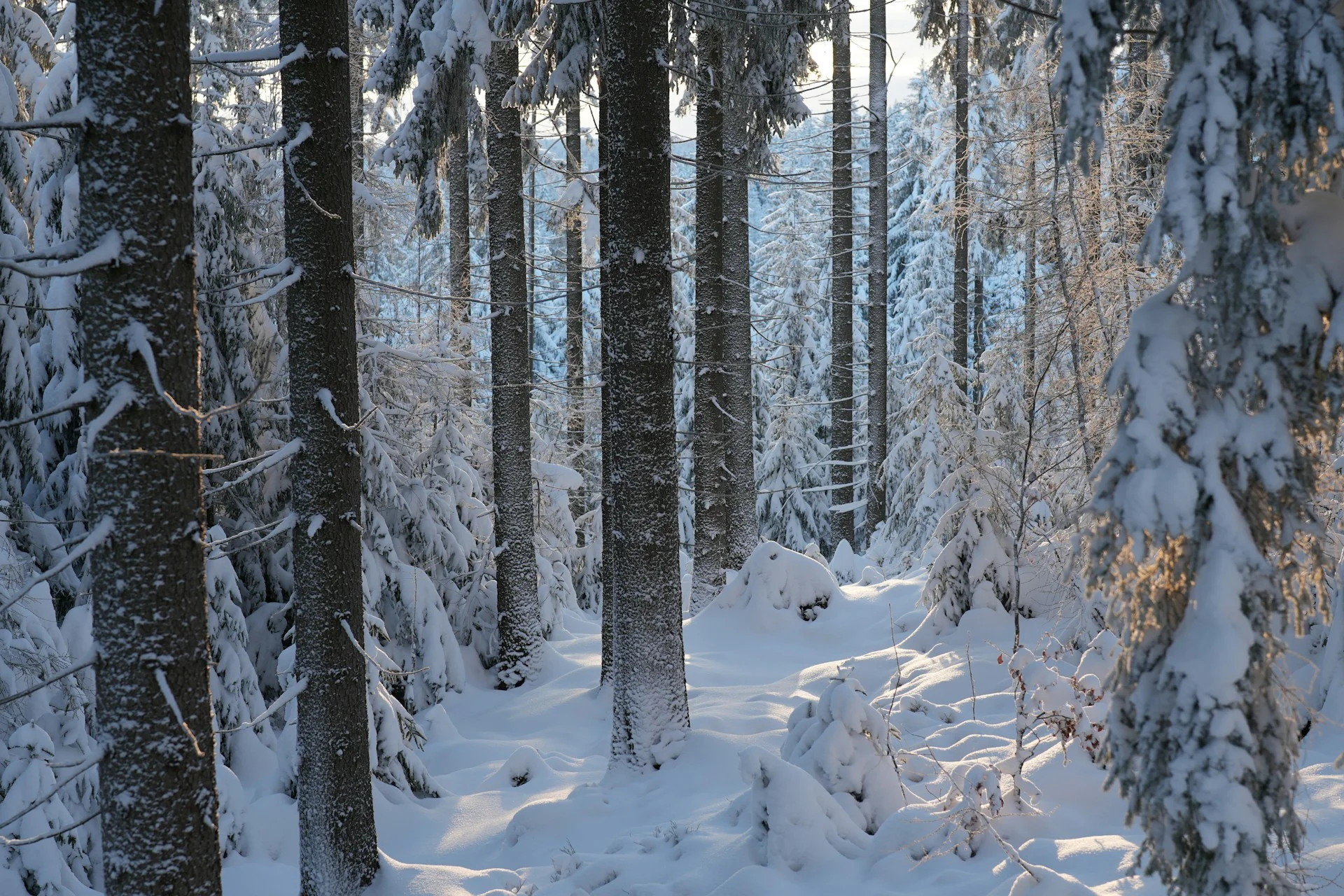
Snow is rarely one uniform white in a photograph. The surface turns toward and away from the light, collecting pale greys and blue-tinted shadows. Some areas are smooth enough to read as broad shapes. Others are interrupted by branches, uneven ground or a darker object just below the surface.
Rather than searching for the brightest spot, compare two neighbouring pale areas. Look for a change that describes a small rise or a hollow. The contrast may be slight, yet it can make the ground feel solid. Winter photographs often reward this attention to differences that would be easy to miss in a thumbnail.
Trunks make a loose rhythm
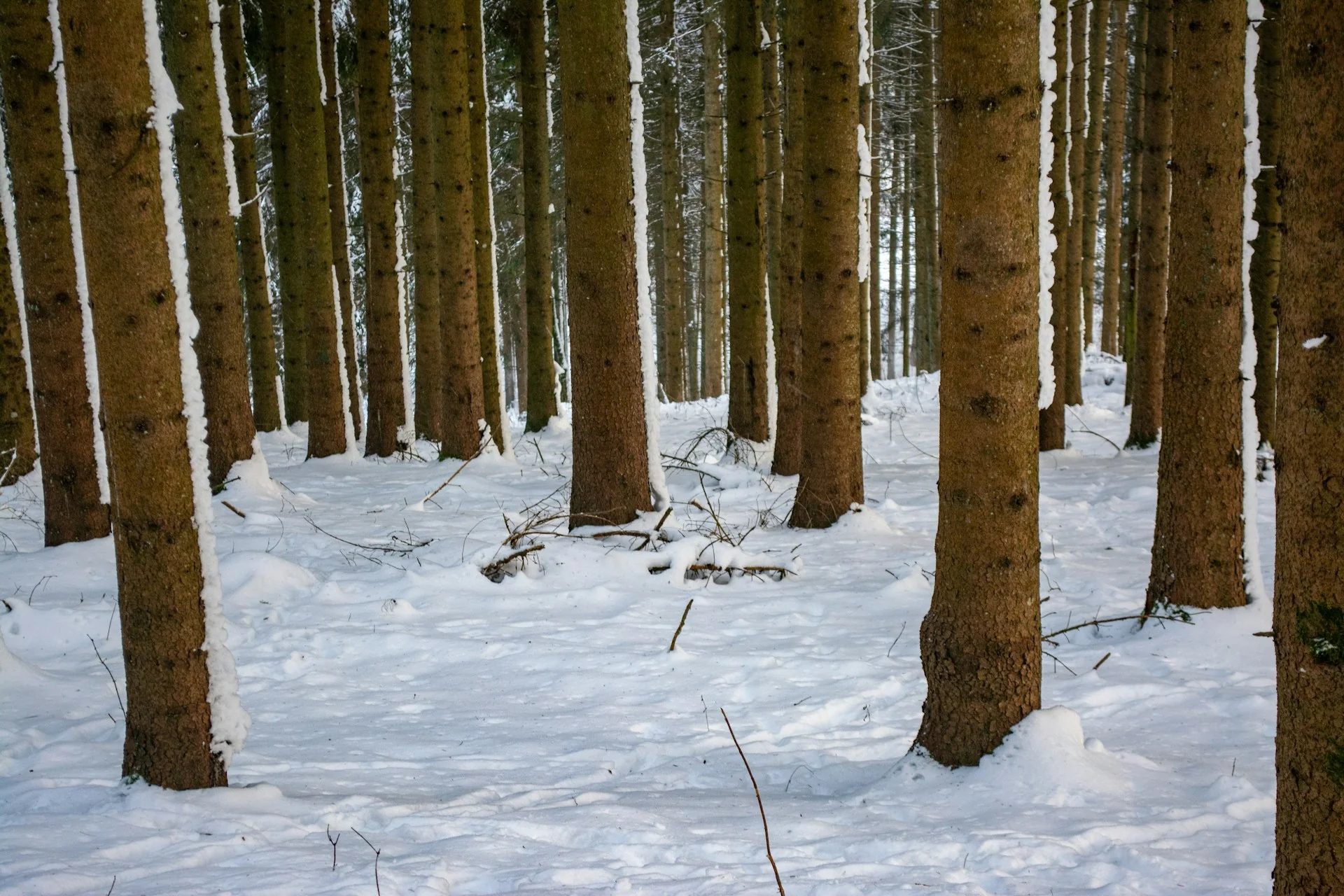
The forest study arranges many vertical trunks across a pale ground. They are related, but never evenly spaced. A larger trunk near the edge interrupts the finer lines behind it. A small opening lets the view continue farther into the frame. Those changes in spacing make the forest feel deep.
Try reading the gaps as shapes. A narrow strip of snow between two trees has a different weight from a wide opening near the centre. Once the empty spaces become visible, the arrangement feels less like a collection of objects and more like a rhythm. The eye moves through intervals as well as along the trees themselves.
Distance can be soft
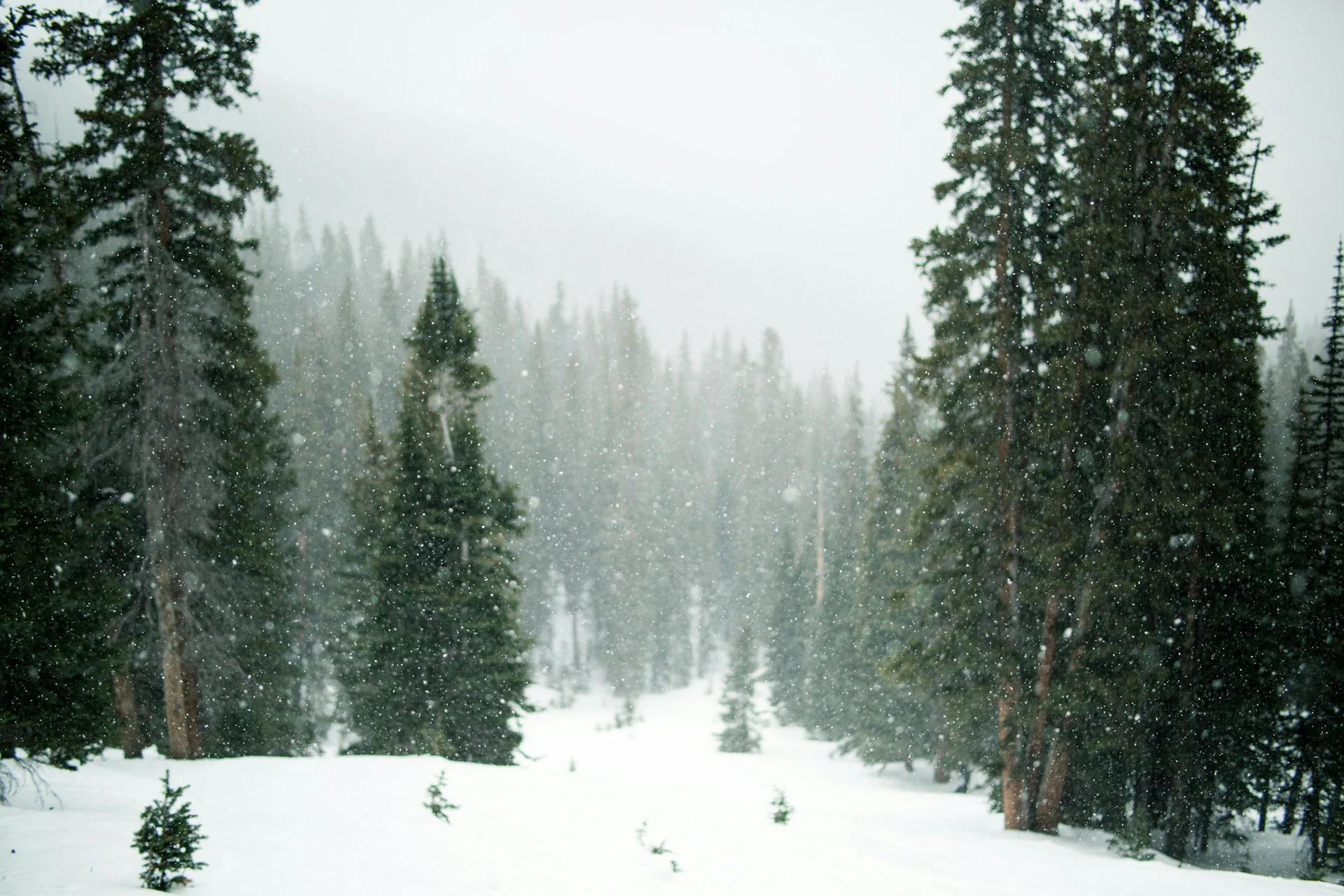
In the falling-snow photograph, trees farther from the camera become less distinct. Their outlines are still useful, but their surface detail is reduced. Nearer branches remain darker. This difference gives the photograph a gentle sense of depth without relying on a strong vanishing point.
The image can suggest quiet, but it does not record silence. Sound, temperature and the feeling of being in a place are outside a still photograph. We use those associations carefully. What the frame actually offers is a visible arrangement of softened shapes, darker foreground branches and pale marks crossing the space between them.
The warmer marks in a pale view
The trunks in the forest study bring brown and muted gold into an image that first appears to be mostly white. Their warmer surfaces provide a counterpoint to the pale ground. A small branch can repeat that contrast at a much finer scale. Winter’s visual character here depends on what interrupts the snow as much as on the snow itself.
Compare the heavier trunks with the slender branches in the path photograph. They offer different kinds of line: one establishes a firm division, while the other makes a lighter network across open space. Follow a single branch until it crosses a pale area, then watch how its visibility changes against a darker tree. The exercise reveals a layered frame rather than a simple collection of winter objects. A restrained range of colour can still contain many different weights, directions and intervals.
A route through a pale frame
The snowy path has a more directed composition. Tall trees establish the sides of the image while the lighter ground leads inward. Fine branches complicate the view above it. The contrast between an open lower area and a more intricate upper area keeps the frame from becoming visually uniform.
This is a study of an image, not an invitation or a route recommendation. The photograph does not tell us about current access or conditions. Its role here is to show how a path can organise a complex scene. Follow that lighter area until it becomes hard to separate from the surrounding snow; notice how little information is needed for the direction to remain legible.