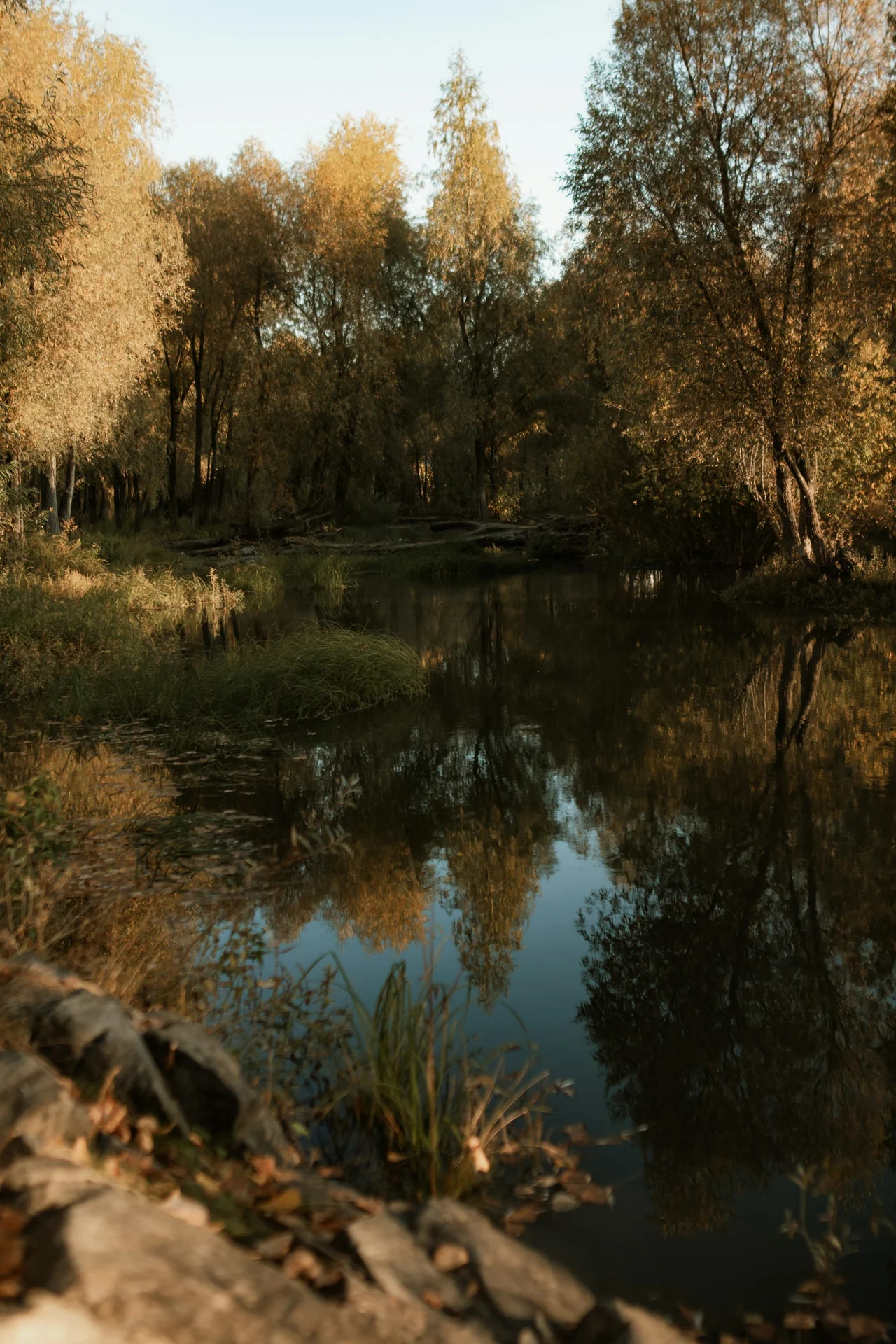
A reflected landscape is recognisable and unfamiliar at the same time. It carries enough of the scene above to make a connection, while changing its edges, contrast and rhythm. The water becomes a second frame inside the first. Looking at that lower picture on its own can reveal a different composition.
Find the point of comparison
In the autumn water photograph, the boundary between land and reflection is a useful starting point. It lets us compare the trees with the shapes below them. Some forms remain clear enough to follow. Others merge into darker areas, and the finer details become difficult to separate.
The reflection does not need to be a precise duplicate to make the connection convincing. A few repeated directions or patches of colour may be enough. Notice which pieces carry the relationship. A single pale trunk or a concentrated warm area can link the two halves even when much of the lower image stays indistinct.
Turn the lower half into a whole
Imagine covering the upper scene. What remains in the water? You may see longer marks, darker colours and a less obvious sense of scale. Without the visible trees above, the reflection starts to feel more abstract. It can be read as an arrangement of shapes before it is read as a landscape.
This does not require rotating or editing the photograph. It is simply a way to divide your attention. After examining the lower area separately, uncover the rest of the scene in your mind. The relationship may feel richer because each portion now has a composition of its own.
A boundary can slow the eye
Many photographs offer a route straight into the distance. A reflection can complicate that movement. Your eye travels toward the trees, notices the waterline and returns downward through similar forms. The image invites a loop instead of a single direction.
The pace depends on how the frame is divided. A narrow area of water may act as an accent. A broad lower field can become a subject in its own right. Neither arrangement is inherently more successful. The useful question is how the amount of space given to the reflection changes the time you spend with it.
Open water works differently
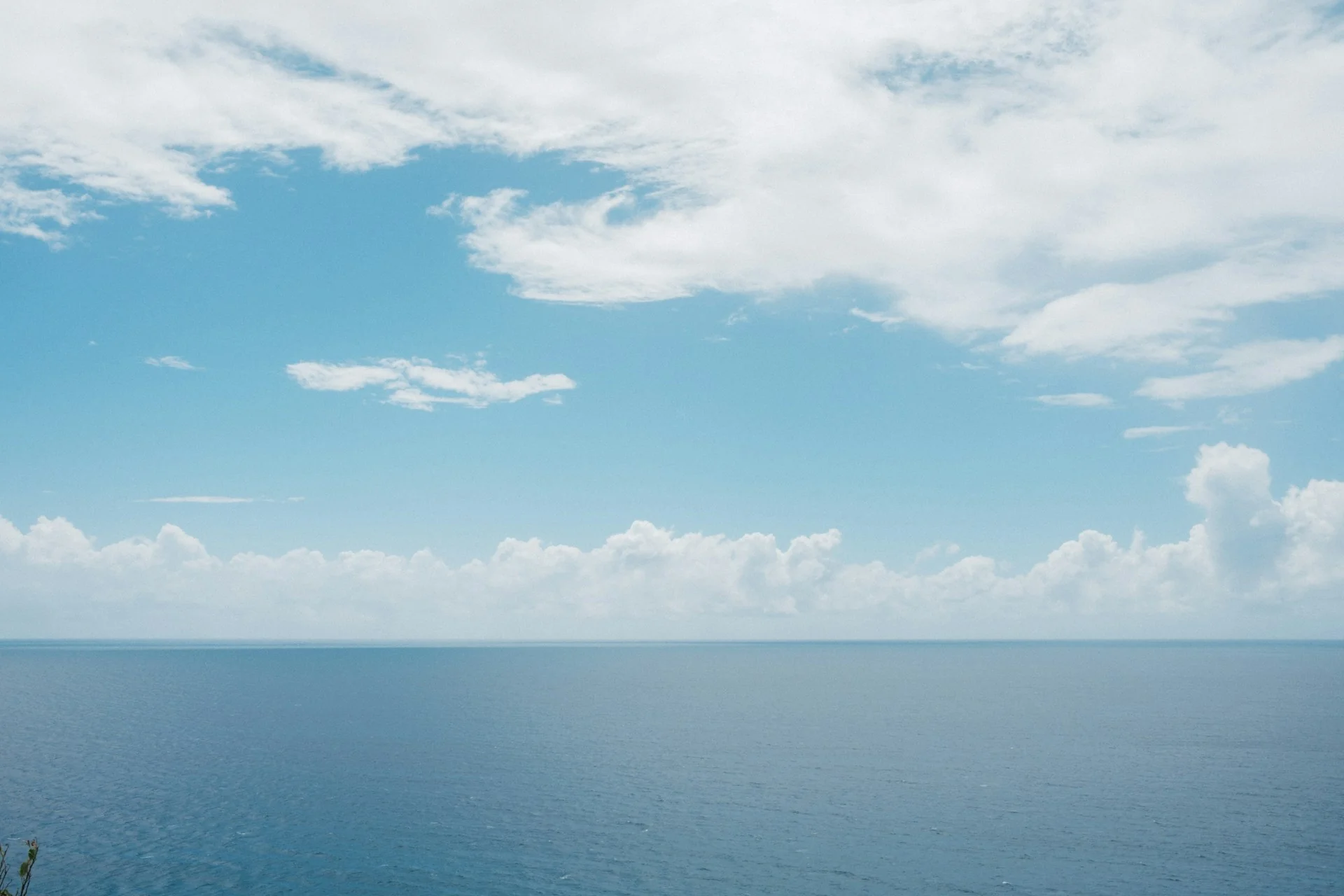
The summer sea photograph has little of the woodland’s mirrored structure. Water reads as a broad surface extending toward a horizon. Its visual role depends more on the relationship between large fields of tone than on recognisable reflected objects. Clouds and the line of the horizon organise the upper part of the frame.
Putting the two images together helps separate water as a subject from water as a compositional device. In one, it creates a second landscape. In the other, it establishes a relatively quiet field. Looking for that role gives us something more specific to say than simply calling both scenes calm.
Leave the unseen conditions open
A still image records a particular visible arrangement. It cannot tell us whether the water remained that way, how the place sounded or what happened just outside the frame. Even a smooth-looking reflection can belong to a brief moment. A careful reading does not turn that moment into a permanent description of a place.
What it can offer is a repeatable act of attention. Find the dividing edge. Compare a shape above it with a shape below. Let the reflected picture stand on its own, then bring the two back together. The scene stays the same, but the way you move through it can change.